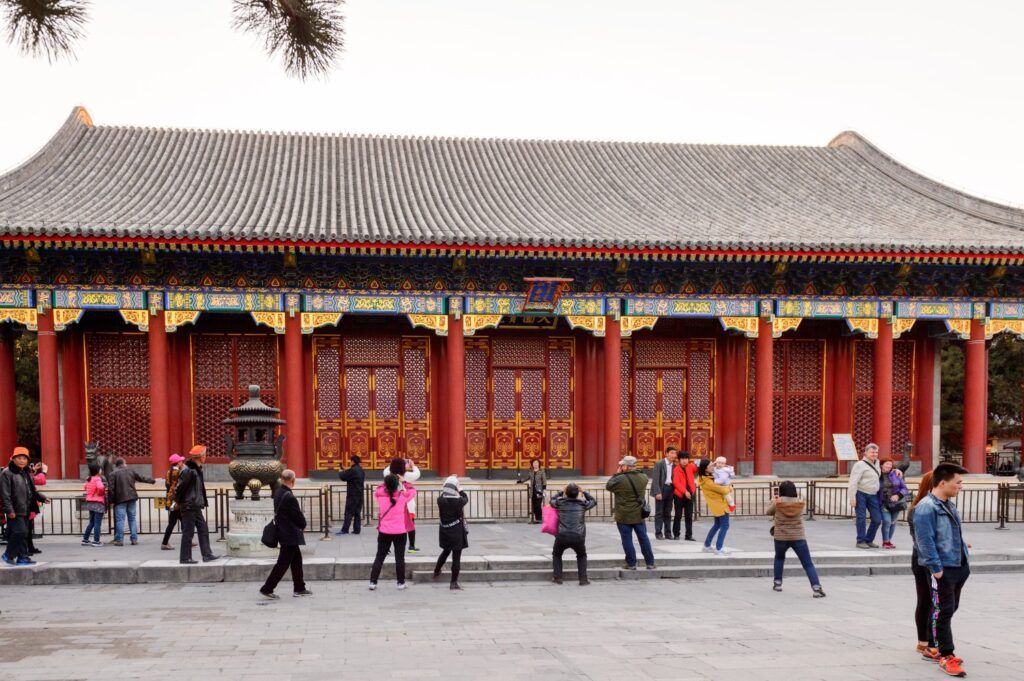
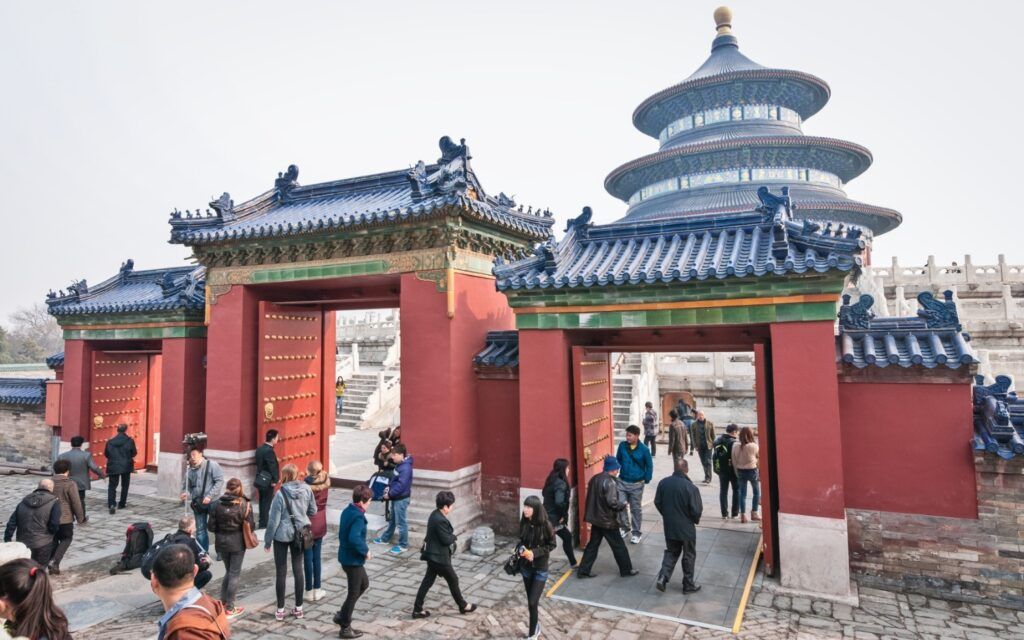
This centuries-old temple complex is sacred ground, quietly set within Beijing’s relentless urban sprawl. Chinese emperors once came here to commune with the divine. At first glance, you might notice scaffolding, traffic noise, or the distant hum of the city. But step inside, and the atmosphere shifts. Tai Chi practitioners begin their slow, deliberate movements among ancient cypress trees, and the site immediately feels alive.
This is what makes the experience so unique in the Chinese capital. Ancient cosmology isn’t sealed behind museum glass; it breathes alongside daily life. Recognised as a UNESCO World Heritage Site, this vast complex represents the largest surviving example of imperial sacrificial architecture in the world. It expresses, with extraordinary clarity, the relationship between Heaven and Earth as understood during the Ming and Qing dynasties. Visiting offers a rare opportunity to explore ritual architecture while observing a space still deeply embedded in local routine.
Why the Temple of Heaven Is Famous: History and Sacred Purpose
The history of the site mirrors the ideological foundations of imperial China. Construction began in 1406 and was completed in 1420 under the Yongle Emperor of the Ming dynasty. It functioned as the ceremonial altar of the “Son of Heaven,” a title reserved exclusively for the emperor, who was believed to act as the intermediary between Heaven and Earth under the Mandate of Heaven.
Despite its name, this was never a place of popular worship. It was an open-air ritual complex used solely by the emperor, who performed highly regulated ceremonies to ensure cosmic harmony, agricultural prosperity, and political legitimacy. Sacrifices followed a strict calendar, and access was forbidden to ordinary citizens for nearly five centuries.
This exclusivity is central to its enduring mystique. The compound remained closed, its rites hidden from public view, reinforcing its symbolic power. Classical Chinese cosmology permeates every detail: circular forms represent Heaven, square layouts signify Earth, and spatial harmony reflects moral order. When the Qing dynasty replaced the Ming, Manchu emperors preserved these traditions with remarkable continuity, reinforcing the site’s spiritual authority.
The Main Altars And Buildings: Symbolism And Architecture
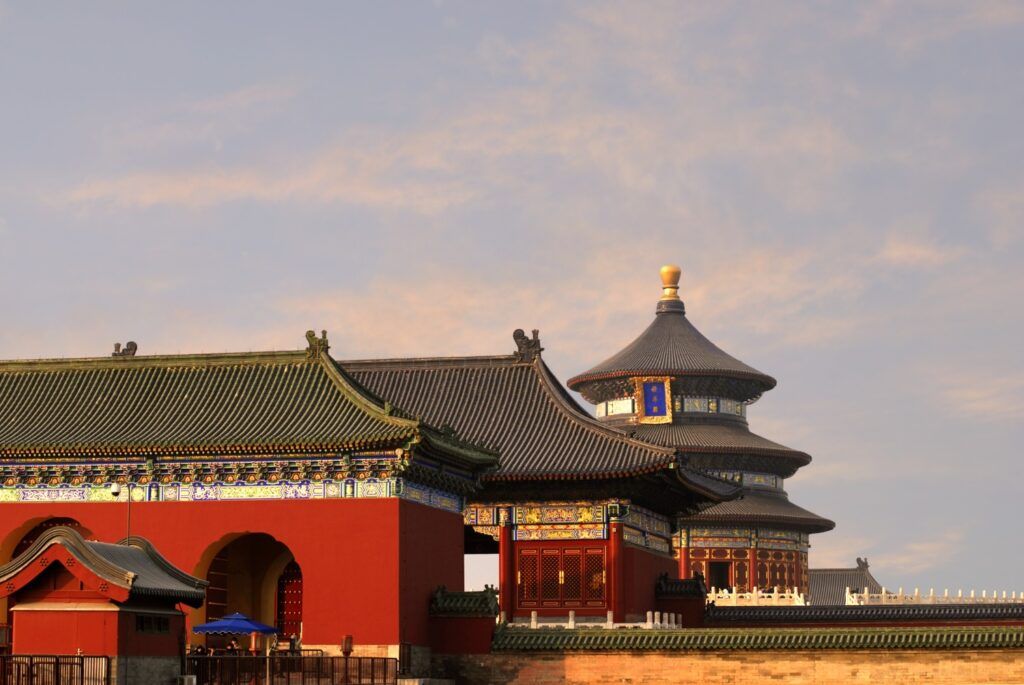
Rather than a single monument, the complex unfolds as a carefully choreographed sequence of ceremonial structures designed to mirror the universe. Three principal elements form its ritual core: the Hall of Prayer for Good Harvests, the Imperial Vault of Heaven, and the Circular Mound Altar. These are connected by elevated walkways and expansive courtyards that guide visitors through a symbolic journey between Heaven and Earth.
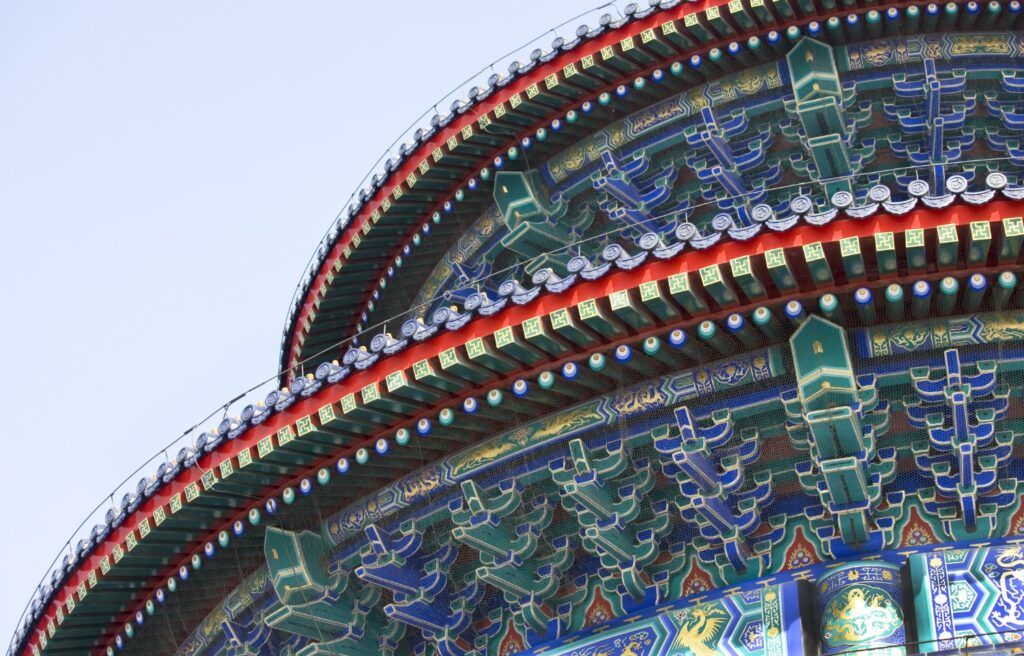
Every architectural choice is intentional. Blue-glazed roof tiles dominate the ensemble, an exceptional colour in imperial China, reserved here to evoke the heavens. Numerical symbolism is everywhere: roof tiles, steps, and balustrades follow multiples of nine, the most auspicious number in Chinese cosmology, representing the nine levels of Heaven.
The layout is mathematical and deeply philosophical. Circular buildings rest on square bases, reinforcing the belief that Heaven is round and Earth is square. The vast open courtyards, elevated platforms, and unobstructed sightlines are designed to inspire humility and awe before ritual even begins. Very few places in Beijing—or anywhere else—convey so powerfully the idea of an emperor standing alone before the cosmos.
The Hall of Prayer for Good Harvests (Qinian Dian)
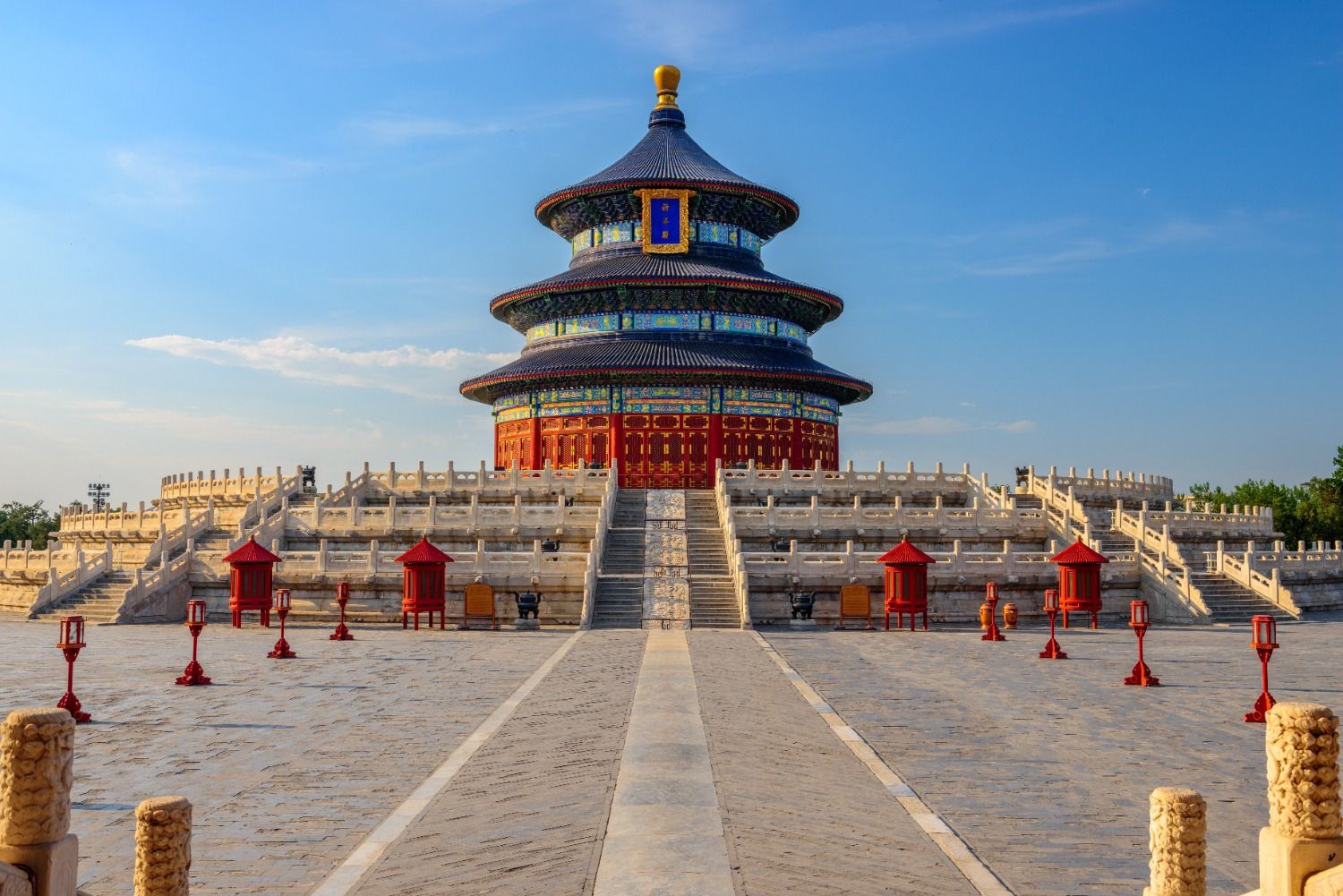
The Hall of Prayer for Good Harvests is the most recognisable structure within the complex and one of the most iconic buildings in Chinese architectural history. Constructed entirely of wood without a single nail, it rises in three elegant tiers atop a white marble terrace, crowned with deep blue tiles.
Despite its monumental scale, the building appears almost weightless, symbolising the vault of the heavens. Its harmonious palette of white, blue, and green softens the structure, reinforcing its spiritual rather than imperial character.
Inside, the columns form a precise cosmological map. Four central pillars represent the seasons. Twelve inner columns correspond to the months, while twelve outer columns reflect the traditional Chinese time system. Standing at the centre, visitors are surrounded by a physical manifestation of time, space, and celestial order as understood in imperial China.
The Imperial Vault of Heaven and the Echo Wall
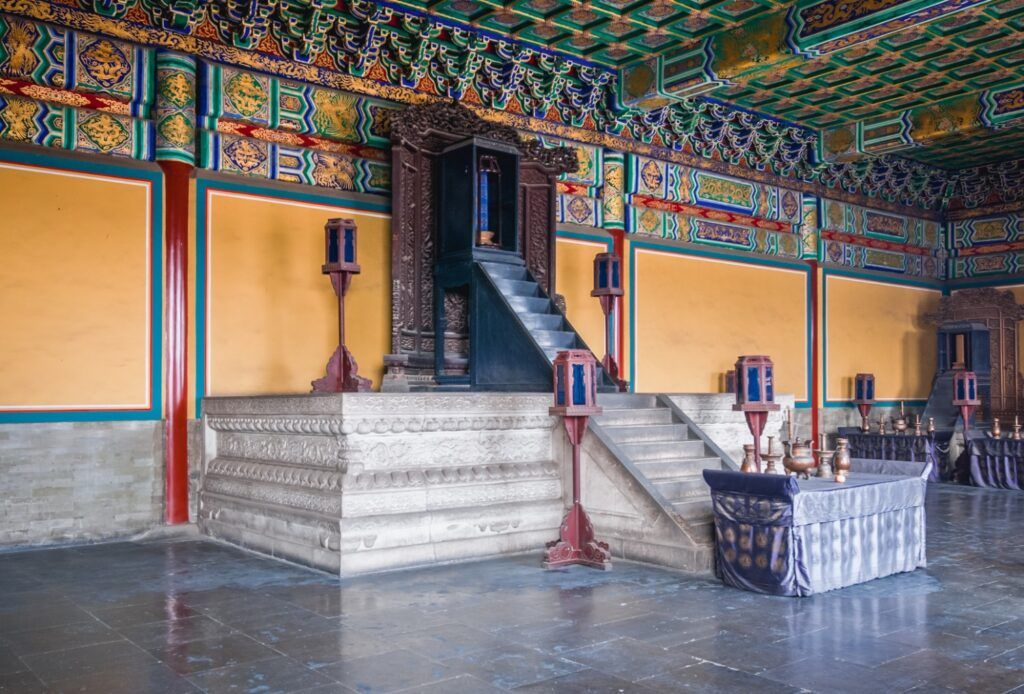
Smaller in scale but rich in symbolism, the Imperial Vault of Heaven once housed ceremonial tablets representing the gods. Here, the emperor paused to prepare spiritually before major rites. Surrounding the building is the famous Echo Wall, a circular enclosure with remarkable acoustic properties: a whisper at one point can be heard clearly across the courtyard.
This acoustic design reinforces the spiritual narrative of prayers travelling upward to Heaven. A useful insider tip is to visit early in the morning, before crowds arrive, to experience the Echo Wall and nearby Triple Sound Stone respectfully and without interruption. Sound and space were integral to ritual experience, not architectural accidents.
The Circular Mound Altar (Yuanqiutan)
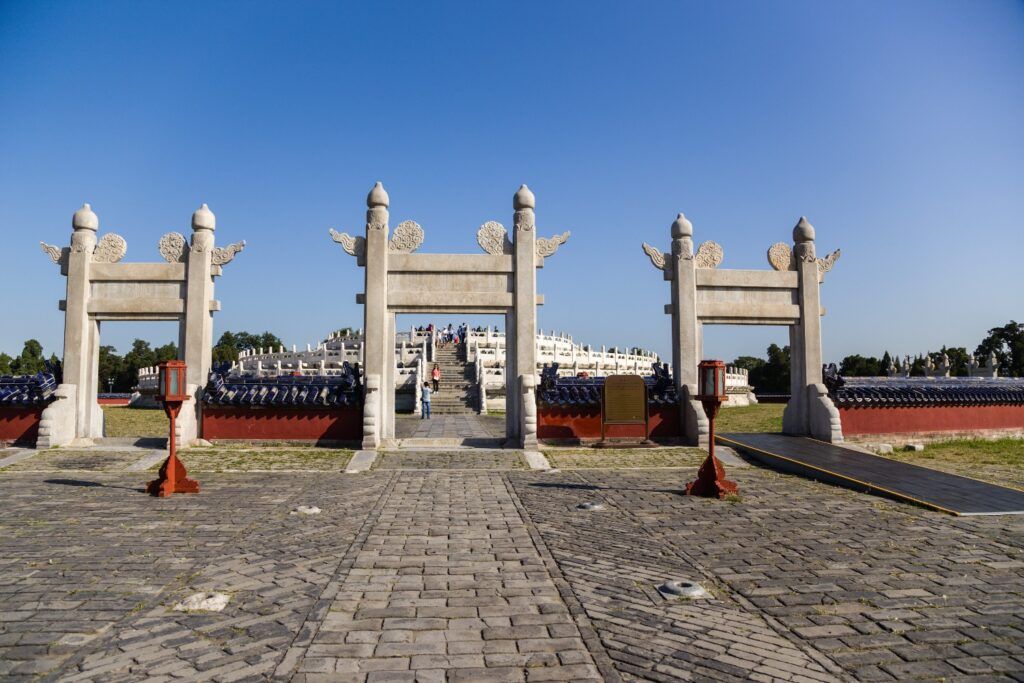
The Circular Mound Altar served as the stage for the most important ceremonies, particularly during the winter solstice, when the emperor directly addressed Heaven. Built entirely of white marble, the altar consists of concentric circular platforms arranged according to a ninefold grid.
At its centre lies the “Heart of Heaven,” a single stone where the emperor stood, completely exposed beneath the sky. Ornamentation is deliberately minimal. There is no shelter, no distraction—only direct communion with the cosmos. The experience remains profoundly humbling even today.
Morning at the Park: The Authentic Beijing Experience
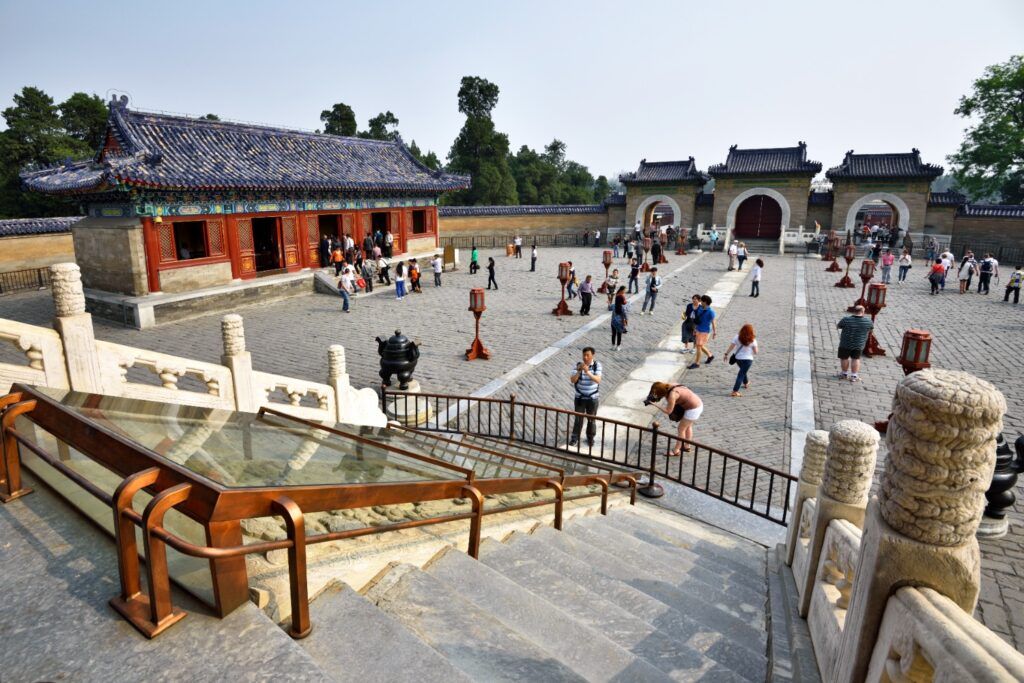
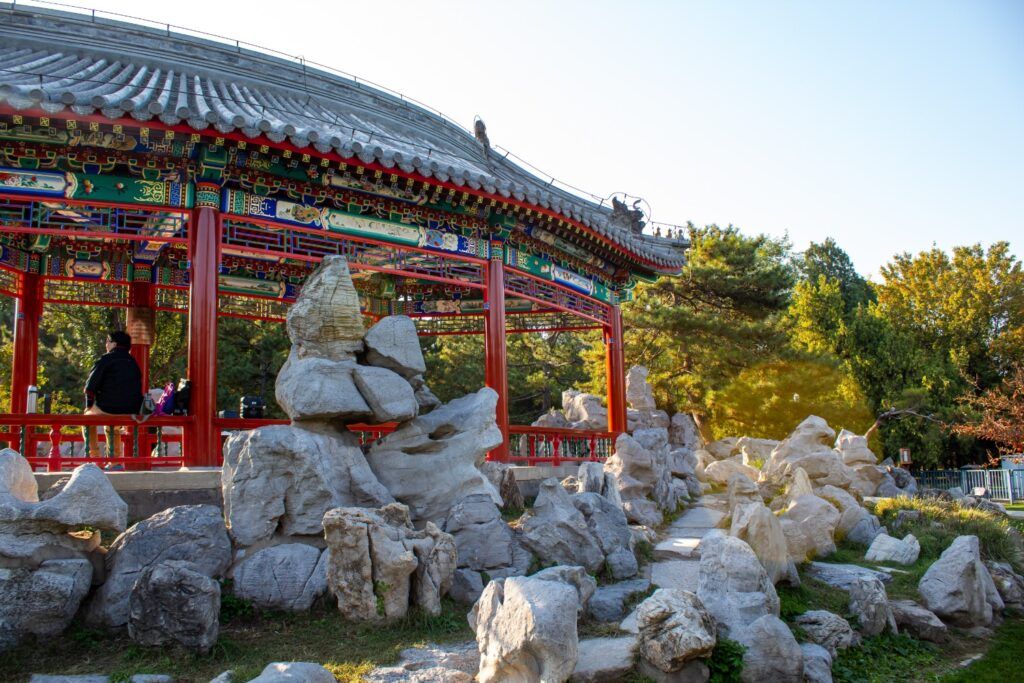
Surrounding the ceremonial structures is a vast public park, more than twice the size of the Forbidden City. This green expanse is one of Beijing’s most important social spaces and gives the site its living character. Early in the morning, before tour groups arrive, the park becomes a microcosm of local life.
Residents gather to exercise, practise Tai Chi, dance, sing opera, play cards, or paint calligraphy with water on the stone paths. The coexistence of ancient ritual architecture and everyday activity ensures that this is not a frozen historical relic, but a space woven into the rhythm of the city.
Social Life in the Park: Movement, Music, and Ritual
Arriving before 9:00 AM—ideally closer to sunrise—reveals the park at its most authentic. Elderly locals move through Tai Chi sequences beneath ancient trees, while others rehearse group dances, sing traditional songs, or practise Chinese opera. Some engage in games like jianzi, the Chinese version of hacky sack.
Visitors are welcome to observe and, occasionally, to participate. Respect is key: ask before photographing, move quietly, and follow the pace of the space. This morning ritual is one of the most memorable aspects of the experience.
Beyond the Rituals: Scale, Space, and Urban Calm
Yes, the park is significantly larger than the Forbidden City. Its wide lawns, long avenues, and open sightlines offer a sense of calm rarely found in central Beijing. This balance between sacred symbolism and urban green space is a key reason for its UNESCO status.
The Danbi Bridge, lined with vermilion balustrades, leads toward the main ritual halls, tracing the path once walked by emperors. Nearby, the Hongqiao Pearl Market offers a more grounded counterpoint, with local specialities and freshly made jianbing—an ideal breakfast stop after an early visit.
Planning Your Visit: Tickets, Timing, and Transport
From a practical perspective, this is one of Beijing’s most rewarding historical sites. Admission consists of a park entrance ticket and a separate pass for the ceremonial buildings. Both are essential for a complete visit.
Allow at least two to three hours to explore the main structures, or longer if you plan to wander the park. Mornings are best for atmosphere and comfort. Transport is straightforward: Subway Line 5 to Tiantandongmen (East Gate) is the most convenient option. Understanding the best time to visit China can also help you avoid extreme weather and peak crowds.
Step into the Emperor’s Sacred Past
Exploring this site is less about ticking off a landmark and more about entering the spiritual framework of an empire. From the precise symbolism of the Hall of Prayer for Good Harvests to the vast openness of the Circular Mound Altar and the everyday vitality of the surrounding park, few places in the world blend ancient ritual and modern life so seamlessly.