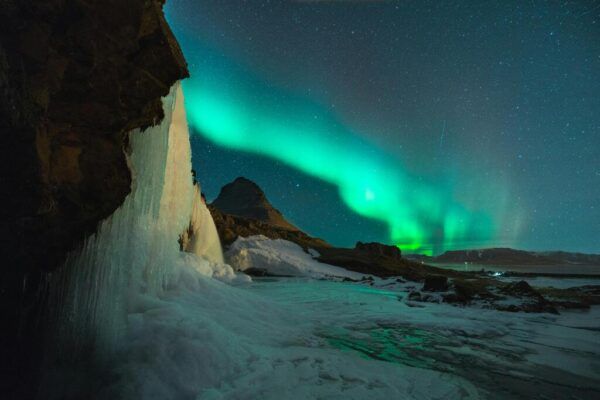
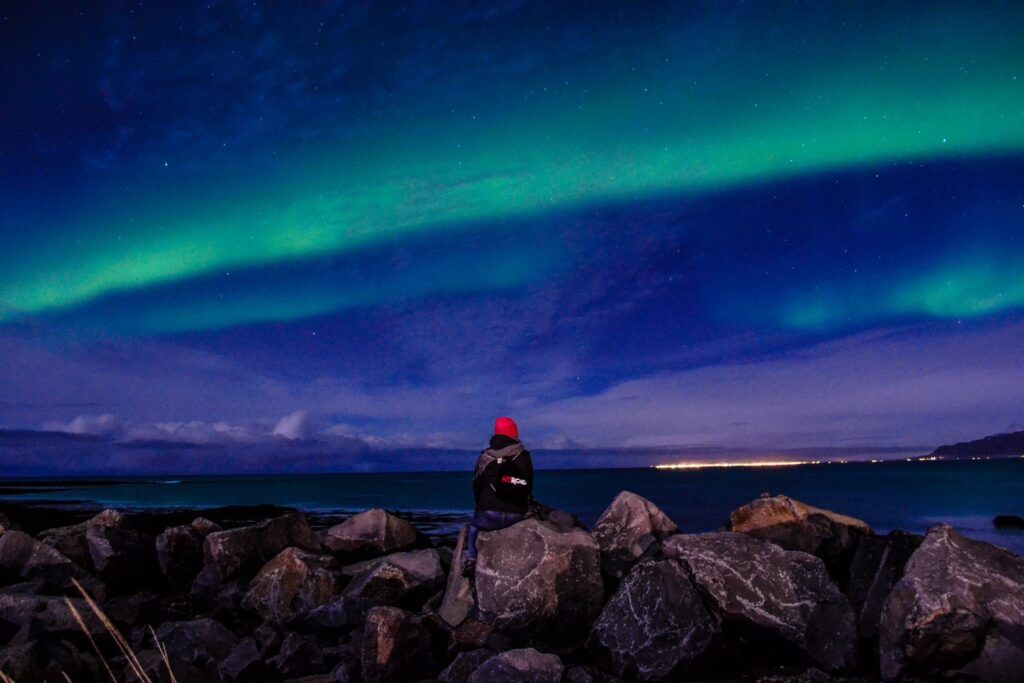
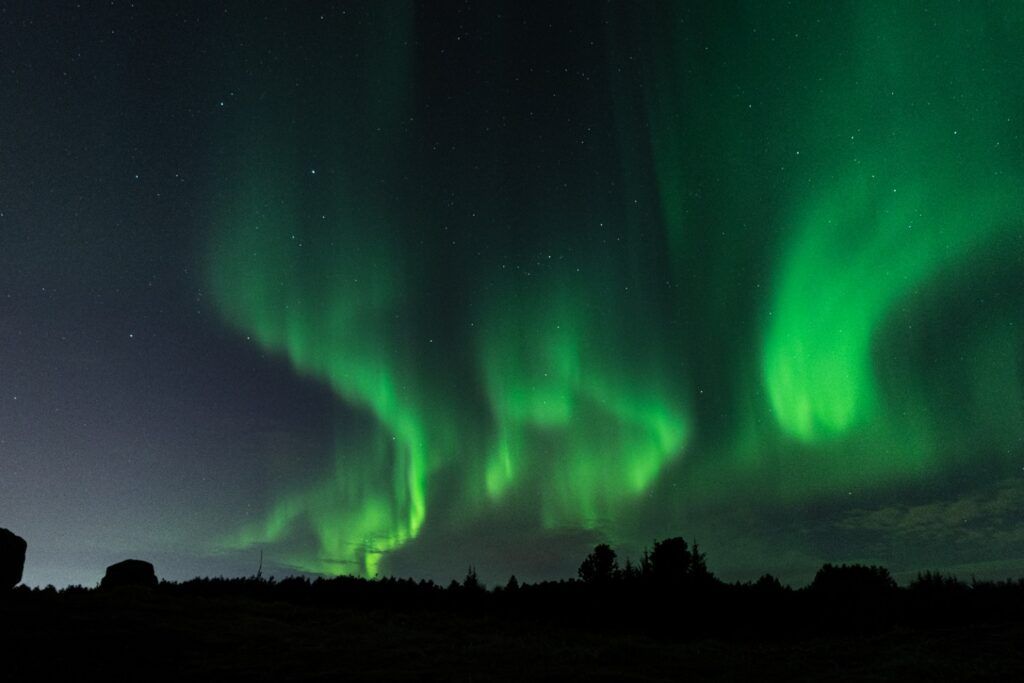
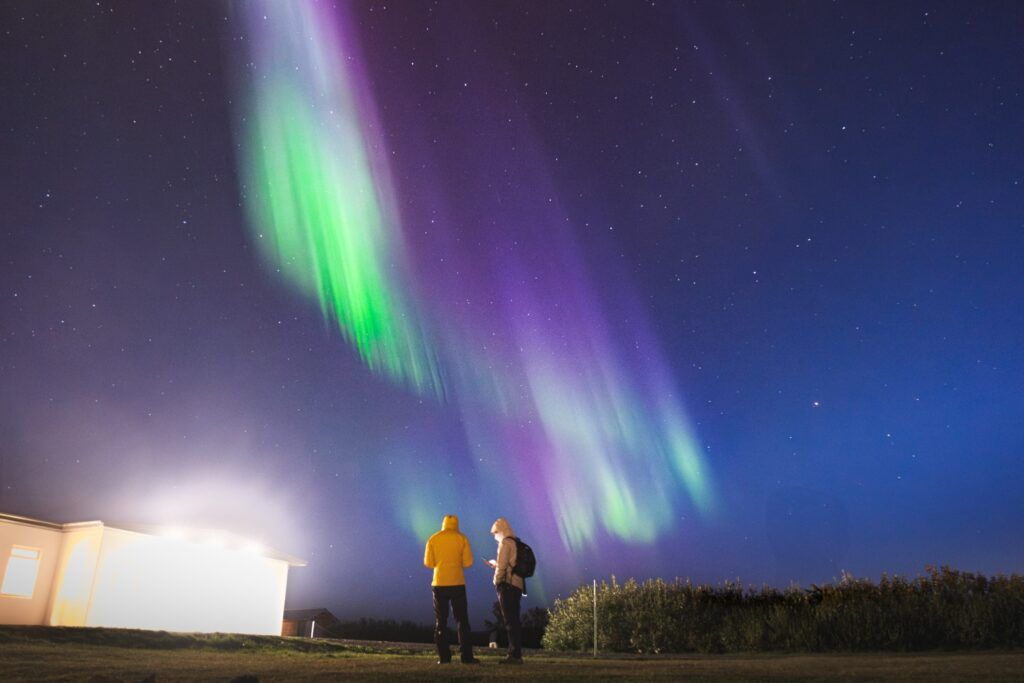
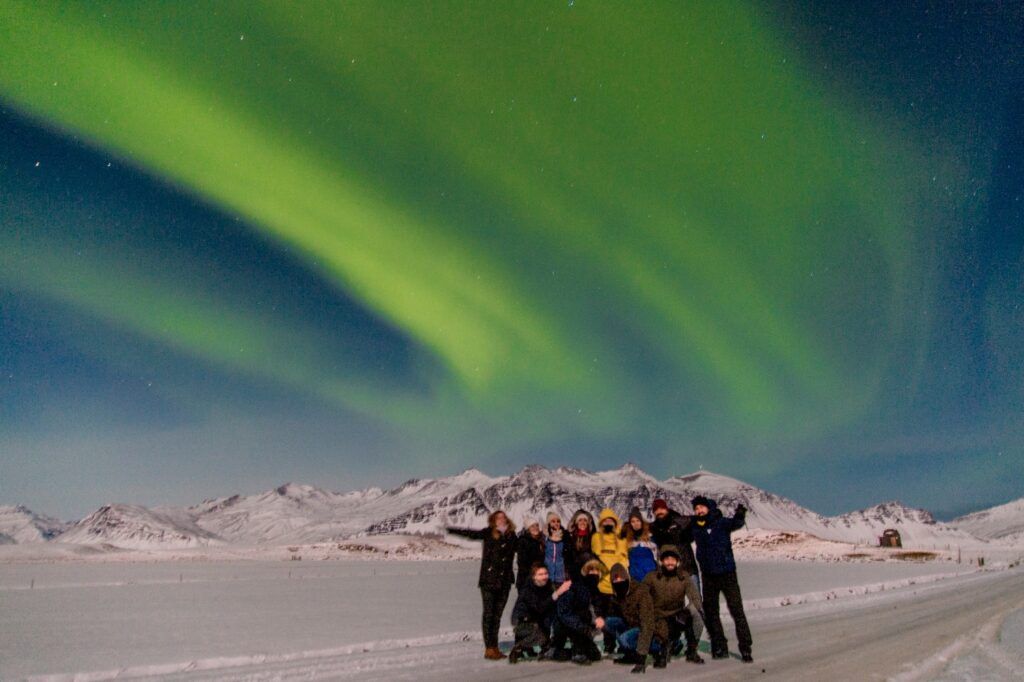
The night is dark, the air is biting, and for a long time, nothing happens. You stand in the silence, checking the horizon more often than your phone, wondering if the wait is worth it. Then, a faint green smudge appears, easy to mistake for a cloud at first. It drifts, brightens, and begins to curve against the obsidian landscape. Suddenly, you realize : you aren’t just looking at the sky; you’re witnessing the Aurora Borealis.
This is the reality of the experience. It is rarely instant or cinematic; it is a spectacle that rewards patience over expectation. While the uncertainty is what makes it unforgettable, standing in the cold shouldn’t be a game of pure luck. The secret to a successful sighting lies in preparation—understanding how timing, location, and solar activity interact. Here is everything you need to know to experience the magic for yourself.
The aurora doesn’t operate on a calendar, but the daylight cycle does. From late May through August, the country barely gets dark, making the lights effectively invisible. The true viewing season is defined by darkness, stretching from late September to early April.
October and March : These months sit close to the equinoxes, often bringing increased geomagnetic activity. October is especially popular : nights are fully dark, but the weather is generally less extreme than in deep winter.
November to January : These months offer the longest nights, providing the most “darkness” for sightings. However, winter storms are more frequent, meaning you need to be ready to embrace the dramatic Icelandic weather.
February and March : As winter begins to fade, skies are frequently clearer. These later months reward those who prioritise flexibility and are willing to wait for the perfect opening in the clouds.
A factor many overlook is the moonlight. While a full moon doesn’t cancel the show, it can reduce the contrast of fainter displays. Many experienced viewers wait for the moon to sit lower on the horizon to truly let the green and purple hues pop against the inky sky.
Top Locations For Viewing The Northern Lights In Iceland
Location matters, but perhaps not for the reasons you think. Proximity to the North Pole is less important than darkness, clear skies, and wide-open horizons.
While many dismiss Reykjavik, if the display is strong, it is easily visible from the city. The real issue is contrast : city lights are so bright they drown out the fainter hues. To see the full spectrum, most people migrate to the peripheries where the darkness allows your eyes to truly distinguish the colours.
Þingvellir National Park : As a primary stop on the Golden Circle, it is open, vast, and among the darkest places reachable without a massive drive. In the heart of the park, it’s often so dark you can barely see your hand in front of your face—perfect for letting the sky take centre stage.
Jökulsárlón Glacier Lagoon : On a clear night, the ice and water reflect the aurora, doubling the intensity of the light. It is remote and silent, making the experience feel entirely disconnected from the modern world.
The Westfjords : This is the ultimate, extreme option. With almost zero light pollution and no “rules,” the Westfjords offer inky blackness. It’s the “real deal” for those seeking the dancing lights in their rawest form.
A note on comfort : The best viewing spots are often the most exposed to the wind. While this provides a clear horizon, it requires the right gear and fortitude to remain stationary long enough to witness the display. Also, a word on the Blue Lagoon : while you can see the lights from there, the resort’s artificial lighting often fails to do the “cosmic ballet” justice compared to the wilder parts of the island.
How To Read The Northern Lights Forecast And Weather Apps
To turn hope into a successful sighting, you must master the balance between the Kp-index and cloud cover. The Kp-index measures geomagnetic activity (0 to 9); for Iceland, a value of 3 is typically sufficient. However, higher values do not compensate for obstructed views. Cloud cover is actually more important than solar intensity. A modest display in a clear sky is far better than a mighty tempest obscured by thick clouds.
The Iceland Meteorological Office provides hourly maps of cloud cover across the island. Knowing how to interpret these allows you to move rather than remain stationary—sometimes the difference between success and failure is just a short drive.
It is vital to remember that a forecast offers probability, not certainty. Experienced observers avoid constant relocation once clear skies are found. Staying put allows your eyes to orient, making subtle movements easier to detect. Many sightings start as ethereal lines in the distance; one of the most common regrets is wandering off too quickly just before the spectacle truly begins.
What to look for in your practical agenda :
Complete darkness instead of lingering twilight
Clear or broken cloud cover
A Kp-index of at least three
Suitable clothing and an endless supply of enthusiasm
Essential Gear For Photographing The Lights
Learning how to photograph the aurora often starts with an inconvenient truth : your phone camera probably won’t cut it. It often snaps a dull green smudge, failing to capture the sight your eyes get accustomed to. To do the lights justice, you need a sturdy travelling tripod. Photography of this nature requires long exposures—often multiple seconds—which is impossible to achieve while holding the camera.
A wide-angle lens is incredibly useful, not because the aurora fills the sky imminently, but because a longer exposure is necessary to capture it as it expands across the frame. Manual settings are worth more than expensive equipment. In most successful shots, the ISO is moderate, the aperture is wide, and shutter speeds are tailored to the movement. If the shutter is open too long, the aurora becomes a blur of light rather than a distinct line; if it’s too short, it won’t register at all.
The cold will be a case of trial and error. Batteries die much quicker than anticipated, sometimes lasting as little as 10 minutes. Carrying spares in inner pockets close to your body heat helps, but nothing fully prevents loss. Perhaps the most important advice is to photograph too much and watch too little. Know when to stop; with your face pressed against the screen, you are no longer able to take in the light dancing above you. Sometimes, the best memories are the ones without a photo.
Why Seeing The Lights Together Changes The Experience
The aurora usually arrives silently, in the company of others who are just as expectant as you. There is a unique bond that forms when a single whisper brings everyone’s gaze to the horizon.
Waiting for the lights is a communal ritual—sharing stories or a thermos of tea. Traveling with a group doesn’t just add a layer of shared anticipation; it allows you to focus entirely on the sky. Your guide knows how to interpret the moving clouds and calibrate your expectations, making the experience steadier even when the lights remain unpredictable.
Sharing The Glow Of The Great Icelandic Sky
The aurora does not end with applause. It fades. Colours thin out. Movement slows. Eventually, the sky returns to black, and the cold reminds you where you are. What stays is not the image, but the memory of standing still while something rare passed overhead.
For most, the best bits are found in the middle of the act. The waiting. The talking. The silent show of patience. This is how you know that the hunt is its own reward. Iceland is a kind land for the engaging traveller. The lights cannot be scheduled or controlled. They can only be met with plans made, flexibility retained, and acceptance that, here, you do not call the shots.
For those hoping to put the idea into motion, tours to see the northern lights in Iceland allow you to get help to focus on your hunt. And for those with a little more wiggle in their departure dates, all our travel itineraries in Iceland show there are as many ways to see the aurora as there are to see the country.
The lights might be why you came. The waiting, the stillness, and the community in shared effort are what you’ll remember in the long haul.