From standing before the Pyramids of Giza to cruising the Nile at sunset, Egypt rewards travellers who come prepared. Before the adventure begins, though, there’s one practical step to handle: entry requirements. Fortunately, getting permission to enter Egypt is far simpler than many expect.
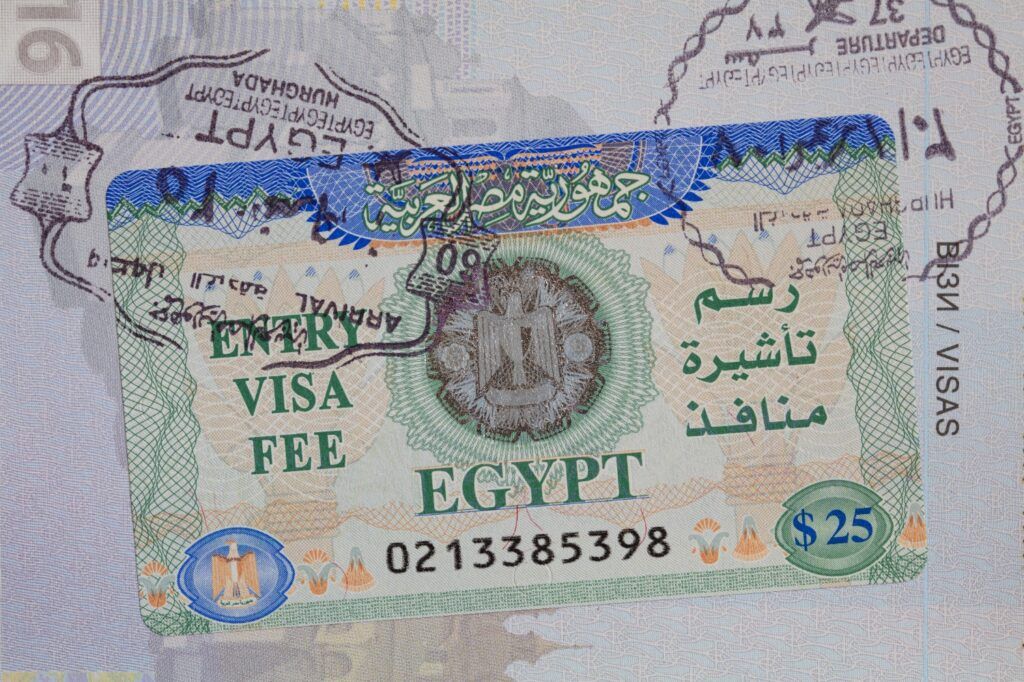
Egypt is not visa-free for most Western travellers, but citizens from the UK, EU, US and many other countries benefit from a straightforward tourist visa system. Visitors can usually choose between a Visa on Arrival, an online e-Visa, or a free Sinai-only entry stamp. For most travellers, the standard single-entry tourist visa costs $25 USD, and the process is transparent and efficient. Once this step is sorted, the focus can shift entirely to the journey ahead.
Travellers heading to Egypt can choose between three official tourist entry options, depending on their nationality, travel style and level of advance planning. All options are approved by the Egyptian government.
1. Visa on Arrival (VOA)
The Visa on Arrival is the most commonly used option for travellers from the UK, EU, US and several other countries. It is obtained directly at the airport upon landing.
Cost: $25 USD
Validity: 30 days, single entry
Issued: At Egyptian international airports, before passport control
Best for: Flexible or last-minute traveller
Travellers purchase a visa stamp at an airport bank counter and then proceed to immigration. The process is usually quick and uncomplicated.
Insider tip: Payment is cash only. US dollars are preferred, though euros and British pounds are often accepted. Carrying small bills speeds things up.
2. e-Visa (Online)
The Egypt e-Visa allows travellers to apply online before departure, offering reassurance before arriving at the airport.
Cost: $25 USD for a single entry / $60 USD for multiple entries
Validity: 30 days per entry
Issued: Online, prior to travel
Best for: First-time visitors and travellers who prefer certainty
Applicants complete an online form, receive an approval document by email, and present it during check-in or on arrival. This option reduces airport queues and avoids any last-minute uncertainty. Only use the official government portal to apply. Third-party sites often add unnecessary fees.
3. Consular Visa
A consular visa is obtained through an Egyptian embassy or consulate and is generally reserved for special cases.
Cost: Varies depending on nationality and visa type
Validity: Varies
Issued: Egyptian embassy or consulate
Best for: Long stays, multiple extended entries, or ineligible passports
This option involves more paperwork and longer processing times and is rarely required for standard tourism.
E-Visa vs. Visa on Arrival: Which Is Faster?
The answer depends on timing. With a Visa on Arrival, approval is immediate at the airport, though queues may form during busy periods. With an e-Visa, waiting happens before travel (usually up to 72 hours), but airport processing is faster.
e-Visa
Pros: Approval in advance, fewer airport queues
Cons: Requires planning ahead and apply at least 7 days pre-departure.
Visa on Arrival
Pros: No pre-travel application required
Cons: Cash payment and potential queues
Recommendation: Travellers on tight schedules or visiting during peak season may prefer the e-Visa. For UK and EU visitors travelling off-peak, Visa on Arrival remains an easy choice. Seasonal travel patterns also matter, so checking the best time to visit Egypt can help align visa choice with crowds.
The Sinai-Only Stamp: The Free Visa Shortcut Explained
The Sinai-only stamp grants a free 15-day entry, but it comes with strict limitations.
Valid only for: South Sinai (Sharm el-Sheikh, Dahab, Nuweiba, Taba)
Not valid for: Cairo, Luxor, Nile cruises or domestic flights beyond Sinai
If there’s any chance of travelling beyond Sinai, a full tourist visa (VOA or e-Visa) is required. Upgrading later can be complex and costly.
Entry Requirements and What to Do If You Overstay
All travellers must meet the following conditions:
Passport valid at least six months from arrival
At least one blank passport page
Airlines regularly enforce these rules before boarding.
Health Requirements
No COVID-19 documentation is currently required. A Yellow Fever certificate is only necessary if arriving from specific endemic countries.
Overstaying your visa
Overstaying can result in fines payable before departure and may complicate future entry. Extensions are sometimes possible, but travellers who realise they have overstayed should address the issue at the airport well ahead of departure.
Once formalities are complete, travellers are free to explore the best places to visit in Egypt without administrative concerns.
Why Egypt Is Better Shared
Egypt’s entry process is affordable, predictable and easy to manage. With the right option chosen, bureaucracy fades quickly behind the scale of what awaits.
Exploring Egypt as part of a group adds another layer to the experience. Sharing ancient temples, desert sunsets and Nile crossings turns discovery into connection. Licensed guides handle logistics, leaving travellers free to focus on wonder, stories and shared moments.